CS-466/566: Math for AI
Module 05: Deep Learning Fundamentals-1
2026-03-23
Introduction
- Goes back to 1940, when people started to build models that imitate the human brain.
- Logistic regression (perceptron) is the core of neural networks started in 1950.
- However, scientists in that time showed that a single perceptron can not solve xor problem (died).
- Reborn in 1980, discovery of merging perceptrons together. But died due to the resources requirements
- Reborn in the last decade with the advancement of the computation resouces.
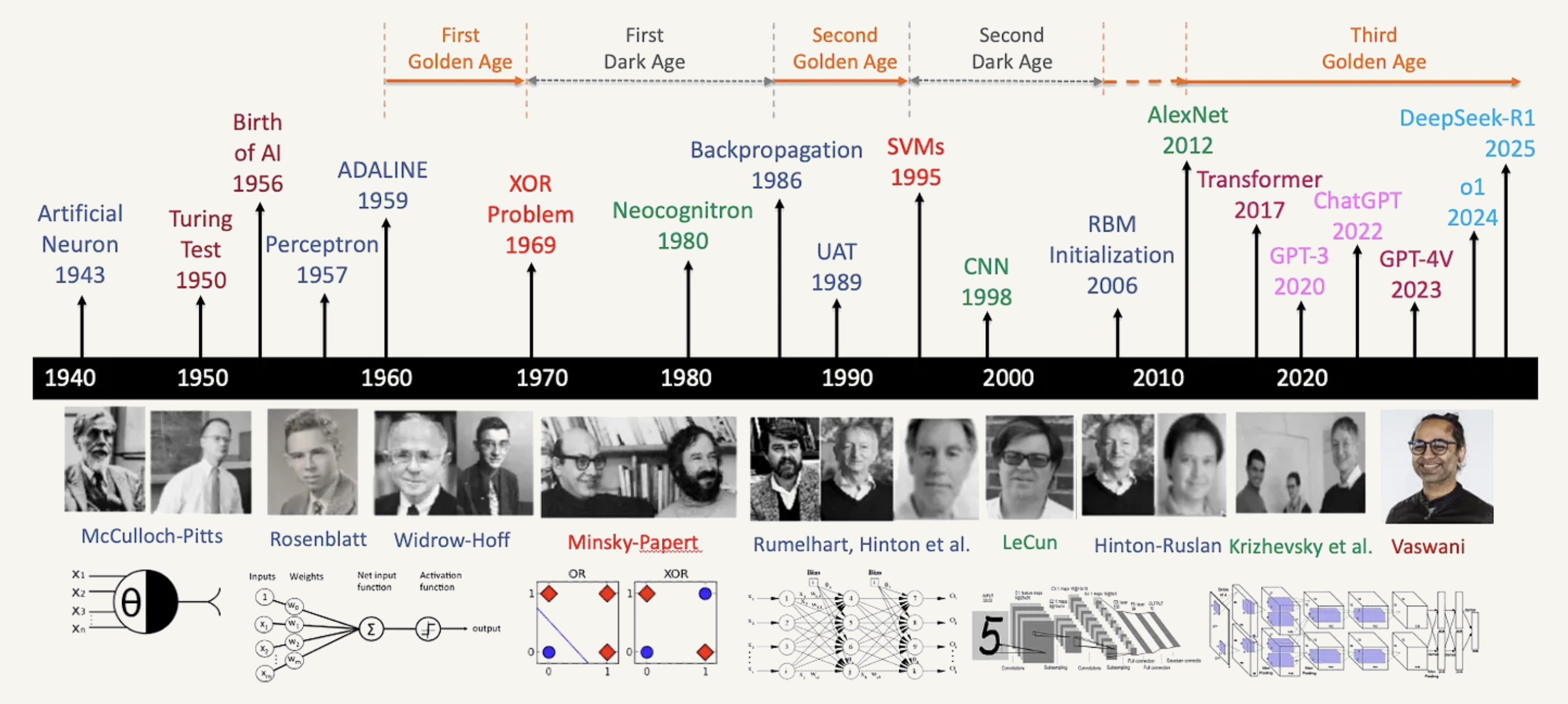
AND Gate Neural Network
Can we build an AND gate using a single perceptron?
| \(x_1\) | \(x_2\) | \(y\) |
|---|---|---|
| 0 | 0 | 0 |
| 0 | 1 | 0 |
| 1 | 0 | 0 |
| 1 | 1 | 1 |
Solution:
\(w_1 = 10\), \(w_2 = 10\), \(b = -15\)
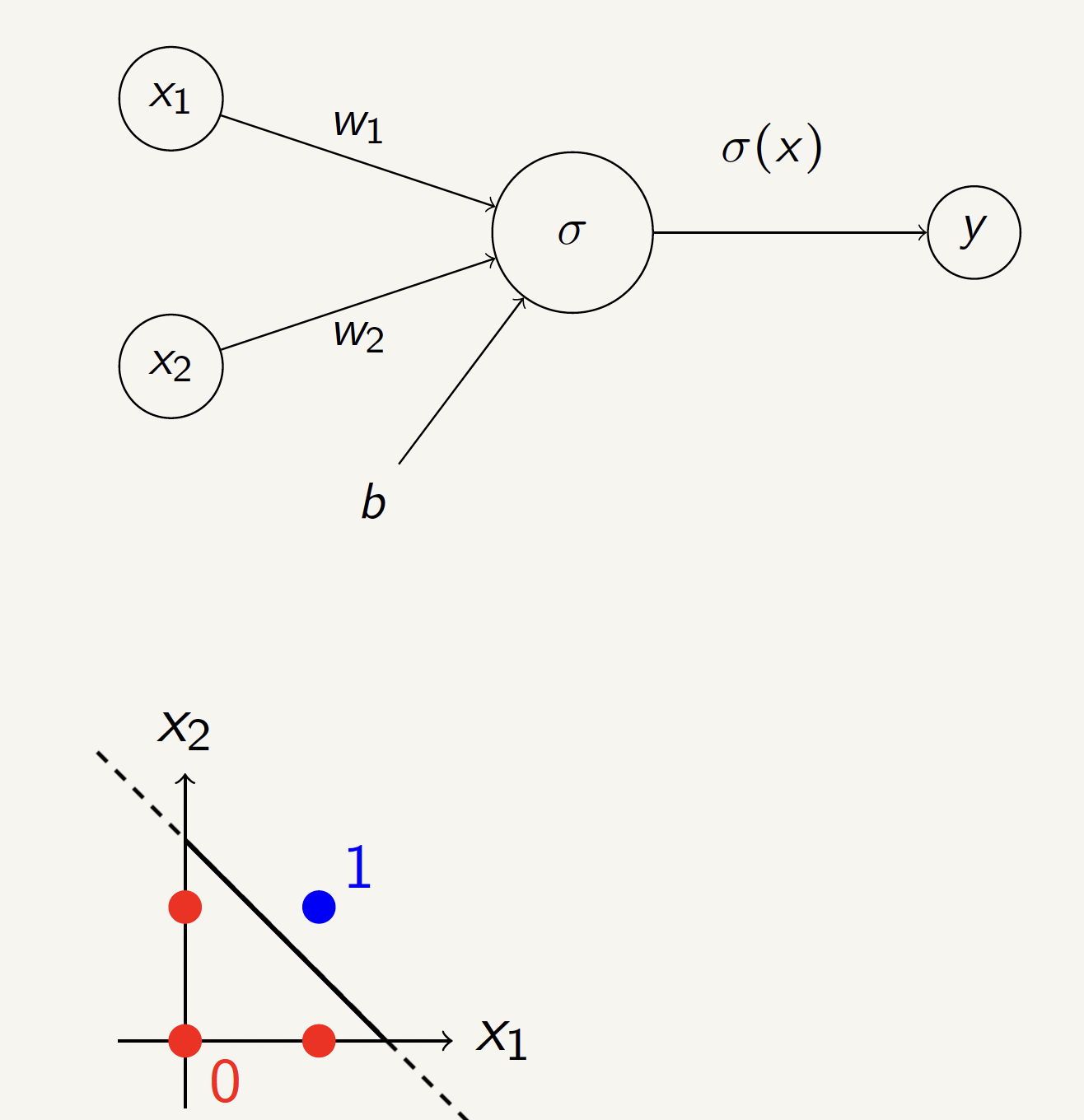
OR Gate Neural Network
Can we build an OR gate using a single perceptron?
| \(x_1\) | \(x_2\) | \(y\) |
|---|---|---|
| 0 | 0 | 0 |
| 0 | 1 | 1 |
| 1 | 0 | 1 |
| 1 | 1 | 1 |
Solution:
\(w_1 = 10\), \(w_2 = 10\), \(b = -5\)
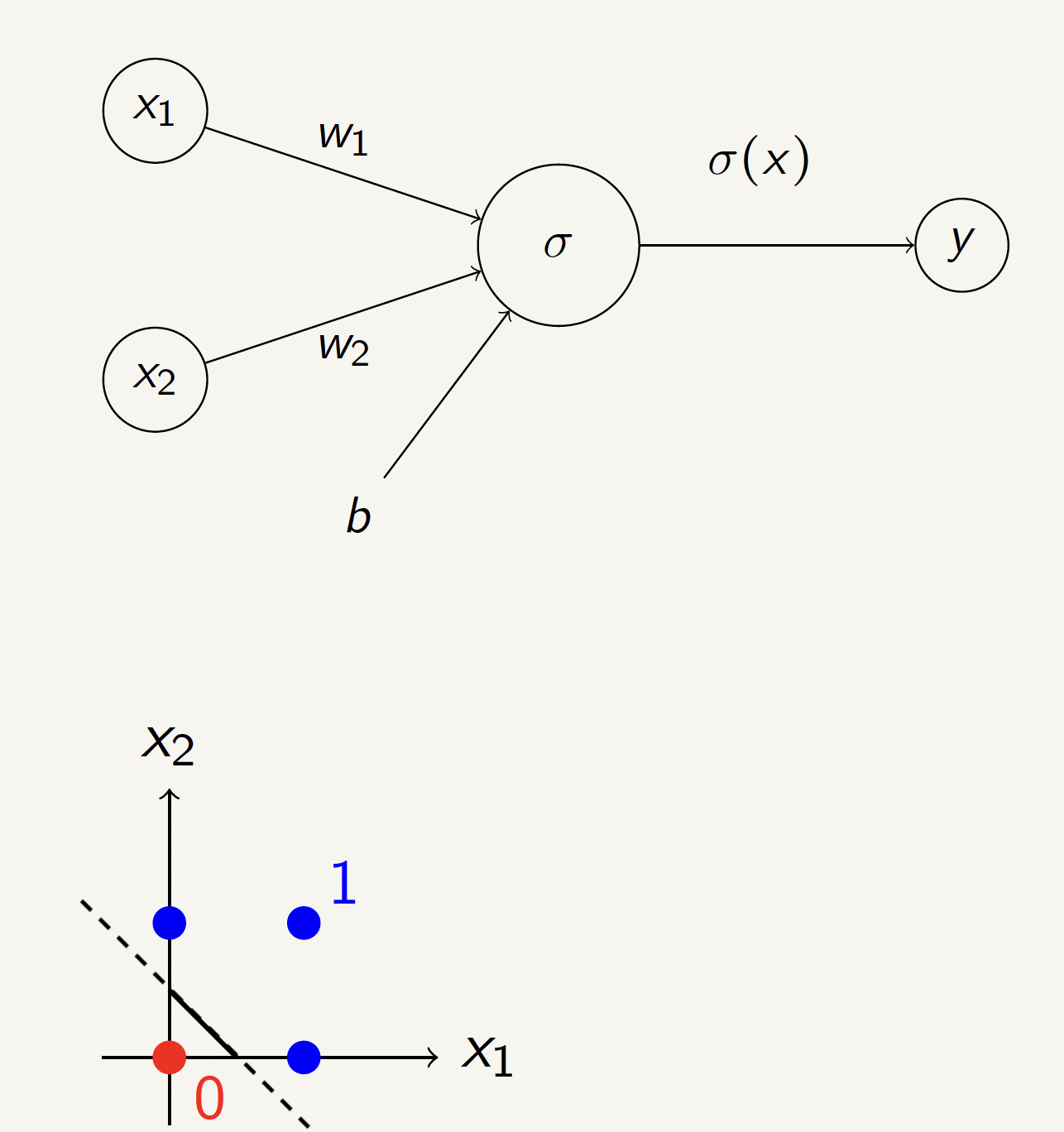
XOR Gate Neural Network
Can we build an XOR gate using a single perceptron?
No! We need multiple layers.
| \(x_1\) | \(x_2\) | \(y\) |
|---|---|---|
| 0 | 0 | 0 |
| 0 | 1 | 1 |
| 1 | 0 | 1 |
| 1 | 1 | 0 |
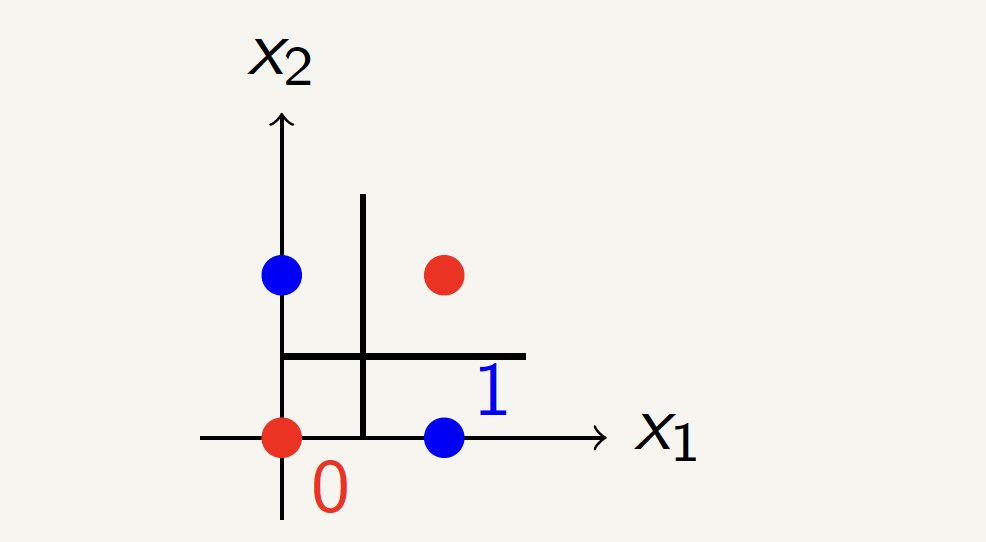
Solving XOR with a Neural Network

Neurons and the Brain

Types of Layers
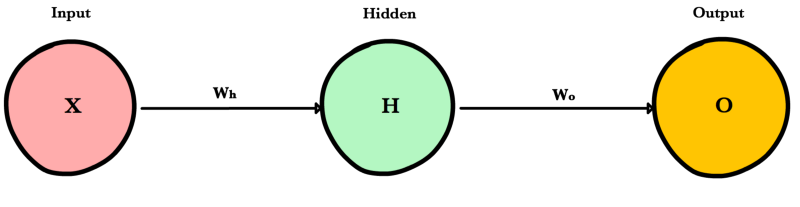
1. The input layer
Introduces input values into the network. No activation function or other processing.
2. The hidden layer(s)
Perform classification of features. Two hidden layers are sufficient to solve any problem.
3. The output layer
Functionally just like the hidden layers. Outputs are passed on to the world outside the neural network.
Neural Network Design

To train a neural network, we need to find the best values for the weights.
This is done using gradient descent algorithm:
\[W \leftarrow W - \eta \frac{\partial L}{\partial W}\]
Example of a Neural Network
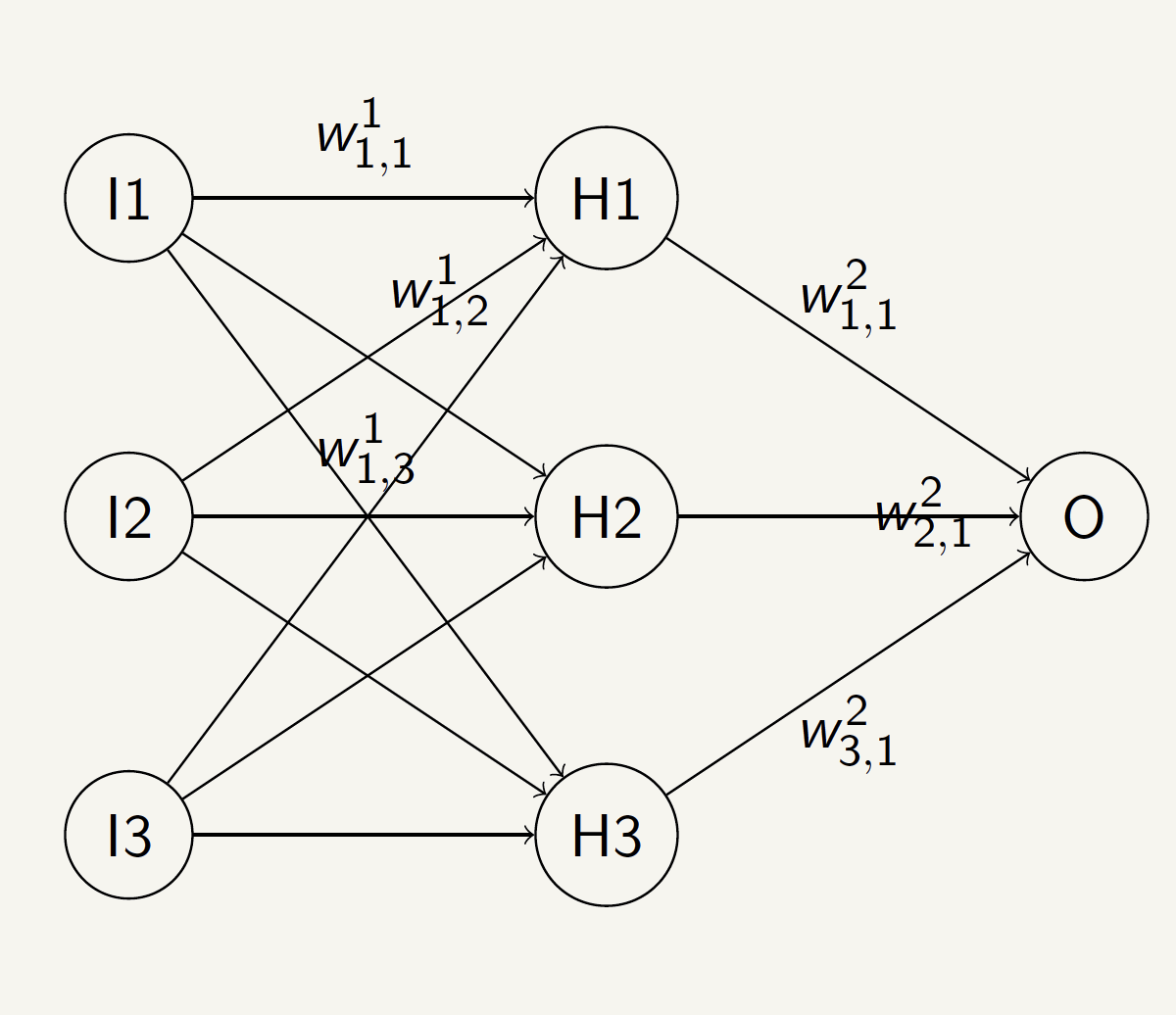
- For neuron (1), the weights are \(W^1_{11}, W^1_{12}, W^1_{13}\).
- For neuron (2), the weights are \(W^1_{21}, W^1_{22}, W^1_{23}\).
- For neuron (3), the weights are \(W^1_{31}, W^1_{32}, W^1_{33}\).
- Superscript \(1\) indicates the first layer.
- Subscript \(1, 2, 3\) indicates the first, second, and third neuron in the layer.
Neural Network As Computational Graph
Suppose we have a neural network with one hidden layer and one output layer to predict the probability of a house being sold given (size, bedrooms, and bathrooms)
For simplicity, no bias term and no weights for the output layer, only average:
This is a composition of functions:


Computational Graph [Matrix Multiplication]

Matrix Multiplication: Training works on batches of data (e.g. 4 houses)
\[\begin{align*} \begin{bmatrix} x_1^{(1)} & x_2^{(1)} & x_3^{(1)} \\ x_1^{(2)} & x_2^{(2)} & x_3^{(2)} \\ x_1^{(3)} & x_2^{(3)} & x_3^{(3)} \\ x_1^{(4)} & x_2^{(4)} & x_3^{(4)} \end{bmatrix} \times \begin{bmatrix} w_{1,1} & w_{1,2} & w_{1,3} \\ w_{2,1} & w_{2,2} & w_{2,3} \\ w_{3,1} & w_{3,2} & w_{3,3} \end{bmatrix} = \begin{bmatrix} h_1^{(1)} & h_2^{(1)} & h_3^{(1)} \\ h_1^{(2)} & h_2^{(2)} & h_3^{(2)} \\ h_1^{(3)} & h_2^{(3)} & h_3^{(3)} \\ h_1^{(4)} & h_2^{(4)} & h_3^{(4)} \end{bmatrix} \end{align*}\] where \(x_i^{(j)}\) is feature \(i\) of house \(j\), \(w_{i,k}\) is the weight from input \(i\) to hidden node \(k\), and \(h_k^{(j)}\) is hidden node \(k\)’s value for house \(j\)
Computational Graph [Sigmoid]
Sigmoid: it is applied to each element of the hidden matrix
\[\begin{align*} \begin{bmatrix} h_1^{(1)} & h_2^{(1)} & h_3^{(1)} \\ h_1^{(2)} & h_2^{(2)} & h_3^{(2)} \\ h_1^{(3)} & h_2^{(3)} & h_3^{(3)} \\ h_1^{(4)} & h_2^{(4)} & h_3^{(4)} \end{bmatrix} \rightarrow \begin{bmatrix} \sigma(h_1^{(1)}) & \sigma(h_2^{(1)}) & \sigma(h_3^{(1)}) \\ \sigma(h_1^{(2)}) & \sigma(h_2^{(2)}) & \sigma(h_3^{(2)}) \\ \sigma(h_1^{(3)}) & \sigma(h_2^{(3)}) & \sigma(h_3^{(3)}) \\ \sigma(h_1^{(4)}) & \sigma(h_2^{(4)}) & \sigma(h_3^{(4)}) \end{bmatrix} = \begin{bmatrix} a_1^{(1)} & a_2^{(1)} & a_3^{(1)} \\ a_1^{(2)} & a_2^{(2)} & a_3^{(2)} \\ a_1^{(3)} & a_2^{(3)} & a_3^{(3)} \\ a_1^{(4)} & a_2^{(4)} & a_3^{(4)} \end{bmatrix} \end{align*}\] where \(a_k^{(j)}\) is the value of activation node \(k\) for house \(j\)
Computational Graph [Average]
Average: it is applied to each row of the activation matrix
\[\begin{align*} \begin{bmatrix} a_1^{(1)} & a_2^{(1)} & a_3^{(1)} \\ a_1^{(2)} & a_2^{(2)} & a_3^{(2)} \\ a_1^{(3)} & a_2^{(3)} & a_3^{(3)} \\ a_1^{(4)} & a_2^{(4)} & a_3^{(4)} \end{bmatrix} \rightarrow \begin{bmatrix} \frac{a_1^{(1)} + a_2^{(1)} + a_3^{(1)}}{3} \\ \frac{a_1^{(2)} + a_2^{(2)} + a_3^{(2)}}{3} \\ \frac{a_1^{(3)} + a_2^{(3)} + a_3^{(3)}}{3} \\ \frac{a_1^{(4)} + a_2^{(4)} + a_3^{(4)}}{3} \end{bmatrix} \end{align*}\]
Every house now has an average probability of being sold predicted by three neurons.
Chain Rule of Neural Network

What is the derivative of \(O\) with respect to \(W\)?
\(\frac{\partial O}{\partial W} = \frac{\partial U}{\partial W} \odot \frac{\partial V}{\partial U} \odot \frac{\partial O}{\partial V}\)
Should be same shape as W, this symbol \(\odot\) is element-wise multiplication
If each computation node in the graph has a known, easy-to-compute local derivative, we can compute the derivative of the entire graph with respect to the weights using the Chain Rule
Basic Primitive Operations [Addition]
For \(z = a + b\), the gradient of \(z\) with respect to \(a\) is 1, and with respect to \(b\) is 1.

Basic Primitive Operations [Subtraction]
For \(z = a - b\), the gradient of \(z\) with respect to \(a\) is 1, and with respect to \(b\) is -1.

Basic Primitive Operations [Multiplication]
For \(z = a * b\), the gradient of \(z\) with respect to \(a\) is \(b\), and with respect to \(b\) is \(a\).

Basic Primitive Operations [Division]
For \(z = a / b\), the gradient of \(z\) with respect to \(a\) is \(\frac{1}{b}\), and with respect to \(b\) is \(-\frac{a}{b^2}\).

Backward Mode Computational Graph Example
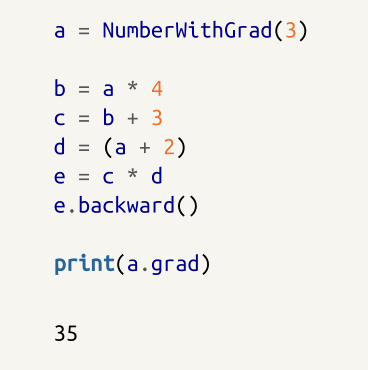
Suppose we have the following equation:

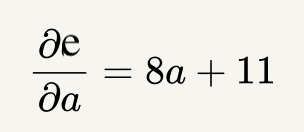
What is \(\frac{\partial e}{\partial a}\) at \(a=3\)?
Derivative Example
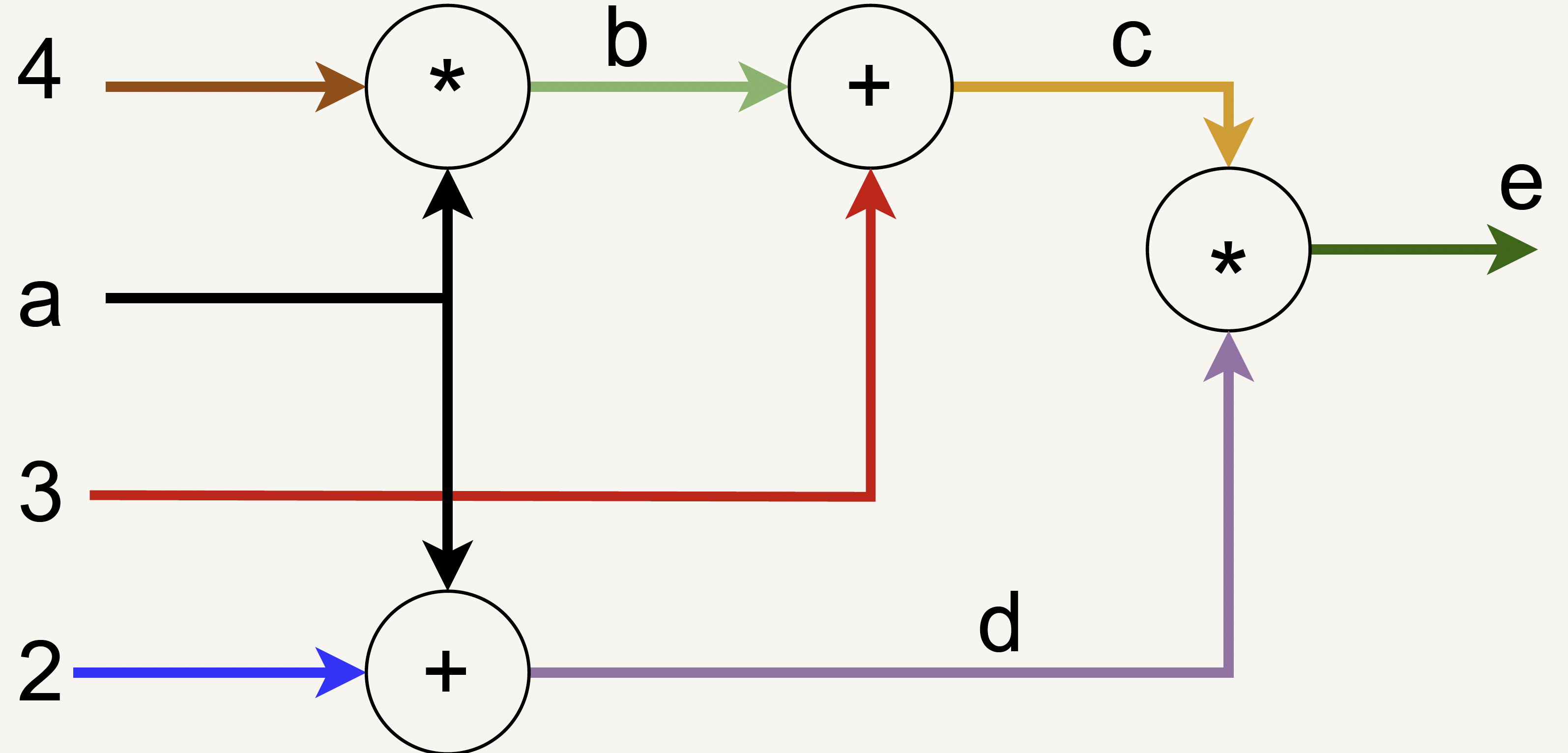
Derivative Example
\(\frac{\partial e}{\partial e} = 1\)
\(\frac{\partial e}{\partial c} = d = 5\)
\(\frac{\partial e}{\partial d} = c = 15\)
\(\frac{\partial e}{\partial b} = 5 \cdot 1 = 5\)
\(5 \cdot 4 = 20\)
\(15 \cdot 1 = 15\)
\(\frac{\partial e}{\partial a} = 20 + 15 = 35\)
Thank You!